

Building a Recognition System For Communities
Honoring Community Over Capital

Disclosure: AI was used for research . All prompts, analysis, synthesis, context, and final content are my own.
Why Language Matters when recognizing volunteer’s contributions
When building community, we often find ourselves in a painful paradox: we need help, people generously offer it, and we have no money to compensate volunteers. As a non-profit, that is very challenging in the early stages. There are only two ways we can do that - through donations and through services we offer. We aim to eventually compensate people financially, but we’re not there now.
The standard tech response? Create “tokens” or “rewards” to gamify contribution.
But here’s the problem: that language is extractive. It frames community building through a capitalist lens where everything has a price, contributions are transactions, and recognition is just deferred payment.
What if instead of mimicking the market, we built a recognition system rooted in organic growth, spiritual abundance, and collective flourishing?
We honor giving rather than accumulation
The Problem with “Tokens” and “Rewards”
Traditional reward systems use extractive language like:
“Earn tokens” - implies labor extraction
“Collect rewards” - suggests transactional value
“Accumulate points” - gamifies contribution into competition
This language feels off because it isn’t aligned with community building. It:
Creates extractive mental models
Implies future monetary conversion
Treats giving as a form of delayed capitalism
Misses the intrinsic value of service
We need different words—words that honor the gift economy, emphasize growth over accumulation, and celebrate consciousness over compensation.
A Note on “Tokenization”
A blockchain-based foundation like Ethereum could be used for the equity compensation, providing transparency and privacy with immutable tracking of contribution. However, in the mental health and psychedelic community, it carries a lot of negative baggage—rightly so. If our community becomes ready to accept that the underlying technology is trustworthy, and it becomes easier to understand and use, then we can add this on later.
Introducing the Lifecycle Recognition System
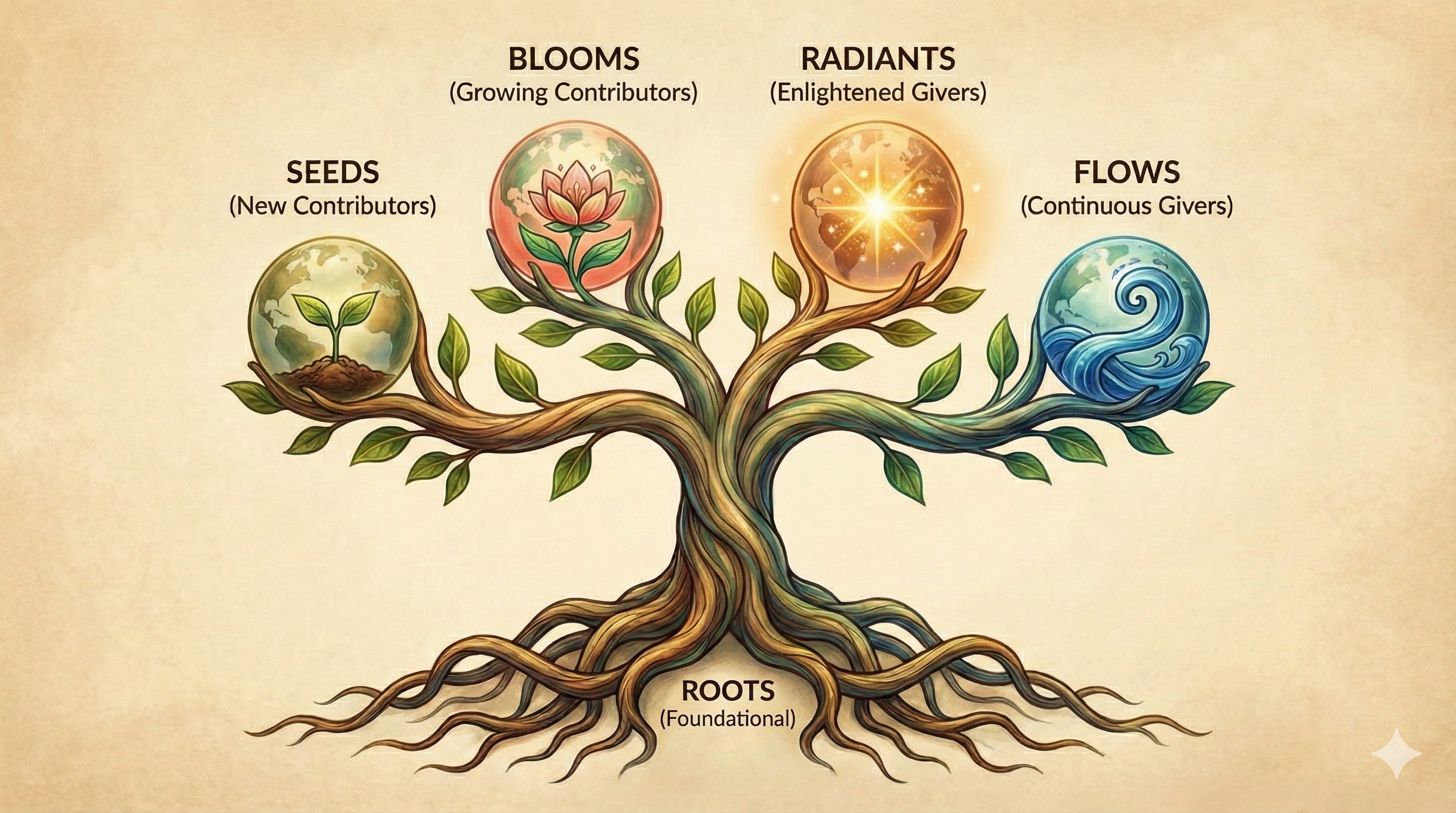
Seeds → Blooms → Radiants → Flows → Roots
Instead of tokens, we developed a lifecycle metaphor where contributions evolve through stages of consciousness and community impact:
1. Seeds 🌱 (New Contributors)
When someone makes their first contribution, they plant a seed in the community. This language emphasizes:
Potential over value
Future growth over immediate return
Planting for collective benefit
2. Blooms 🌸 (Growing Contributors)
As contributions develop and show impact, seeds become blooms—visible, beautiful, adding joy to the community.
3. Radiants ✨ (Enlightened Givers)
When contributions begin to inspire others and create ripple effects, they become radiants—giving off light and energy that illuminates the whole community.
4. Flows 🌊 (Effortless Continuous Givers)
As we become radiant, we reach a state of flow - flow state. Those who give from a place of flow—where contribution feels natural, effortless, and deeply aligned. This is where service becomes meditation.
5. Roots 🌲 (Foundational/Transcendent)
The highest recognition: contributions that become roots—foundational elements that ground and sustain the entire community structure. These are transcendent gifts that last.
How It Works in Practice
Recognizing Contributions
Instead of “You earned 5 tokens,” we say:
“Plant a seed” in recognition of [name]’s contribution
“Honor their service” with acknowledgment
“Celebrate” their giving
Tracking Progress
A contributor’s profile might show:
“You’ve planted 12 seeds, grown 5 blooms, cultivated 3 radiants, achieved 2 flows, and deepened 1 root in the community.”
This communicates:
Quantity: How many contributions (the number)
Quality: How mature each contribution has become (the lifecycle stage)
Evolution Over Time
Each contribution evolves as it matures:
A seed might bloom when progress is made
A bloom might become radiant when it inspires others to contribute
A radiant might enter flow when it becomes sustainable and self-generating
A flow might become a root when it becomes foundational infrastructure
The Technical Implementation
The recognition system is purely visual and metaphorical—no blockchain, no cryptocurrency, no financial instruments. Just recognition.
Future-Proofing: From Recognition to Compensation
Here’s the powerful part: if a non-profit raises funds later, this system can translate to equity.
We’re exploring the Slicing Pie model—a dynamic equity split framework where:
Early contributors earn more than later contributors (time-weighted)
Different contribution types have different multipliers
The “pie” dynamically adjusts as people contribute
Our lifecycle stages could map to multipliers like:
Seeds: 1x base rate
Blooms: 1.2x (showing sustained impact)
Radiants: 1.5x (inspiring others)
Flows: 2x (continuous effortless contribution)
Roots: 2.5x (foundational infrastructure)
This means:
We honor volunteers now with meaningful recognition
We track contributions transparently
If funds arrive, we can convert recognition → equity fairly
Early community builders get rewarded for taking the risk
But crucially: the system works without money. The recognition has intrinsic value. The potential for future compensation is bonus, not promise.
Why This Matters
1. Psychological Health
Volunteers don’t feel exploited because we’re not pretending to pay them with fake currency. The recognition is honest about what it is: gratitude and honor, not deferred compensation.
2. Community Culture
Using organic, spiritual language creates a different culture than using capitalistic language. People come to serve, not to extract. They give from abundance, not scarcity.
3. Sustainable Motivation
Intrinsic motivation (service, growth, meaning) is more sustainable than extrinsic motivation (tokens, points, future money). Our language supports the former.
4. Ethical Clarity
We’re not making promises we can’t keep. We’re honest: “We have no money now, but we deeply honor your service.” If money comes later, we have a fair system. If not, the recognition stands on its own.
The Bigger Vision
This isn’t just about volunteer recognition. It’s about building an alternative to venture-backed, extraction-based startup culture.
Imagine communities where:
Contribution precedes compensation
Recognition has intrinsic value
Service is honored spiritually first, financially second (if at all)
Early community builders are protected if resources arrive later
This model works for:
Community projects without funding
Co-ops and collectives building slowly
Open source projects seeking sustainability
Mutual aid networks formalizing contribution
Intentional communities tracking participation
We don’t need to import capitalist language into community spaces. We can create recognition systems that honor the gift economy, celebrate consciousness, and build culture around service rather than extraction.
And if money shows up later? Great!—we have a fair system to translate seeds into equity. But the seeds have value either way.
The recognition is not a placeholder for payment. It’s a celebration of what was freely given.
Why this Model is easily adapted
Seeds → Blooms → Radiants → Flows → Roots:
Combines lifecycle metaphor with recognition - Most systems use static currencies (hours, credits, points). Ours evolves organically.
Purely symbolic yet convertible - Most systems are either (a) purely symbolic with no future value, or (b) immediately transactional. Ours is symbolic first, potentially convertible later.
Consciousness-based progression - Time banking tracks hours equally. Slicing Pie tracks multipliers. Ours tracks spiritual evolution of contribution.
Non-extractive language - Even “good” systems use market terms. We’ve consciously built a non-extractive vocabulary.
Community-specific customization - Our system is designed for intentional communities / vertical villages, whereas most models aim for universal application.
We see this as closest to Time Banking + Slicing Pie combined, but even that doesn’t capture the spiritual/consciousness dimension that makes ours distinctively useful for building communities with a systems approach.
The TL;DR version is Kropotkin’s WHY. Ours is the practical subset of the HOW as articulated by Sara Horowitz. One can think of this as Applied Mutual Aid for Intentional Communities. We took the same approach when it came to Ethics - applied and practical.
Research Sources
Peter Kropotkin: “Mutual Aid: A factor of Evolution (1902)”
Sara Horowitz: “Mutualism: Building the Next Economy from the Ground Up” (2021)
Slicing Pie Model: slicingpie.com
Gift Economy Theory: Lewis Hyde’s “The Gift: Creativity and the Artist in the Modern World”
Community Building: “The Art of Community: Seven Principles for Belonging” by Charles Vogl
Commons Based Peer Production: “The Wealth of Networks”
Open Source The System
We’re building this in the open. The recognition framework will be available for any community to adapt.
Plant seeds. Watch them become roots. 🌱→🌲
Written for communities building alternatives to extractive capitalism, one contribution at a time.
🙏🏻 With gratitude to the Human Flourishing Community at the Frontier Tower that have been developing the framework for building catalytic communities 🙏🏻
About the Author