

Your Place, Your Elected Representatives: Two Scores to Help You Vote!
The Mind Lumen framework for measuring psychedelic policy safety and political accountability — four case studies

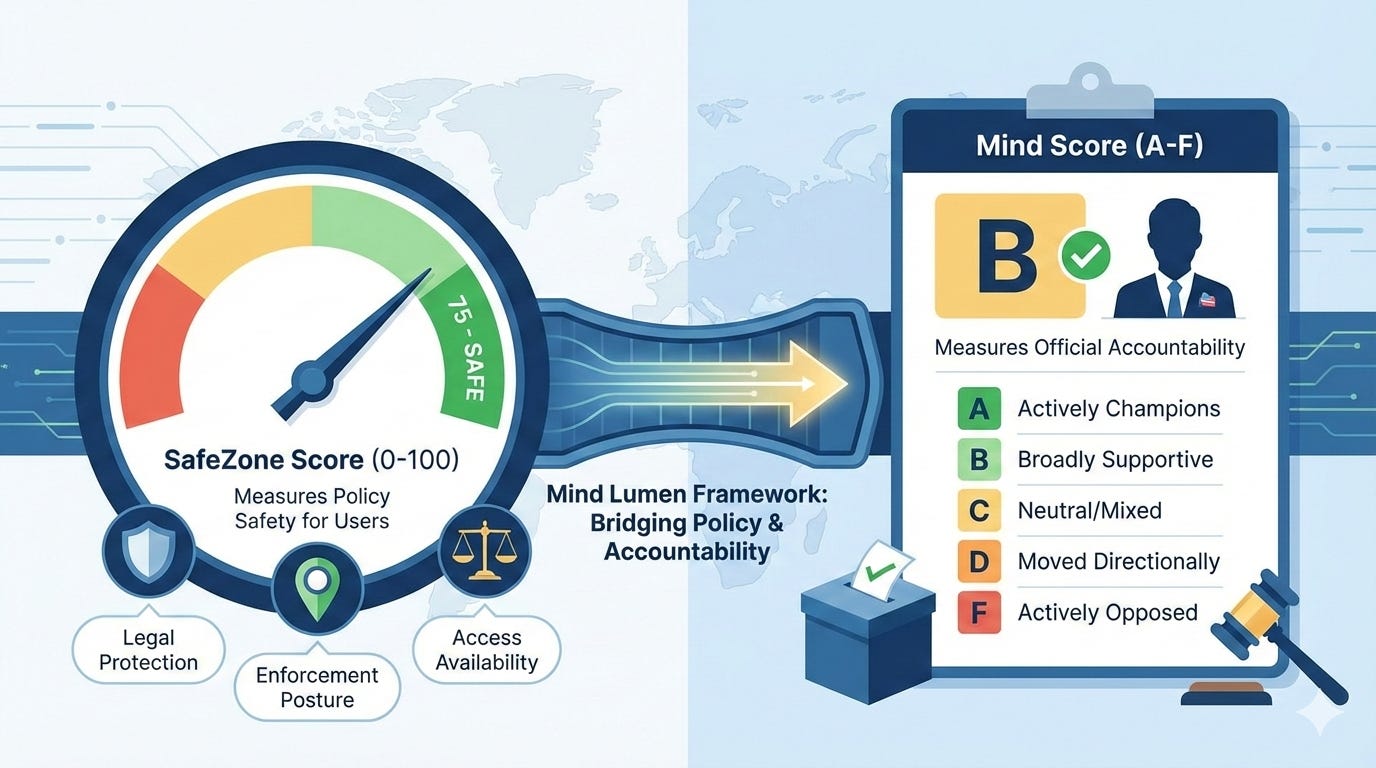
Mind Lumen is a 501(c)(3) non-profit focused on Ethics, Education, Policy, and Advocacy to democratize access equitably, for mental health and pro-active cognitive wellbeing
A Framework for Psychedelic Policy: Score Cards
Understanding how to change psychedelic policy — and who to hold accountable for it — requires answering two distinct questions.
The first is asked by anyone who uses or facilitates access:“If I’m in Oregon right now and I use psilocybin for my cognitive wellbeing, how likely am I going to be arrested and prosecuted?”
The second is asked by anyone who votes: “The politicians who represents me is talking about mental health access — are they actually doing anything about it?”
These are genuinely different questions. They require different data, different analysis, and different answers. The gap between them — between what the law says and what officials actually do — is where accountability lives.
Mind Lumen is researching and planning to build a framework to answer both.
This post introduces the two scores, explains what goes into each, and walks through what four jurisdictions around the world illustrate about the distance between policy on paper and policy in practice. The goal is not to declare winners and losers. It is to give seekers, providers, voters, and advocates the verified information they need to make informed decisions — and to hold their officials to account regardless of party or affiliation.
We hope this starts a dialog within psychedelic societies, communities, non-profits, news media, and advocacy organizations. We welcome that dialog.
The Mind Lumen Ethical Policy Score™ (Mind Score):
“Are elected officials walking the talk — deeds, not words?”
The Mind Lumen Ethical Policy Score™ — the Mind Score — answers the civic accountability question. It applies to individuals only: a legislator, a governor, a DA, a sheriff, a city council member. Not to states or jurisdictions. Every election season, officials claim to care about mental health. Do They?
The Mind Score measures what they’ve actually done about it in support of making psychedelics accessible — in votes, budgets, legislation, and demonstrated behavior.
”We need to study it more”, “there is not enough evidence”, “It is not safe” etc are excuses to avoid dealing with the mental health crisis. Psychedelics have already proven to be way safer, non-addictive, and causes the least harm among the substances that are available. See the Imperial College of London study that is cited in numerous reputation journals, like the Economist.
Mind Scores are displayed publicly as letter grades, not numbers. Numeric precision implies a certainty the data doesn’t support; grades communicate the meaningful signal clearly.
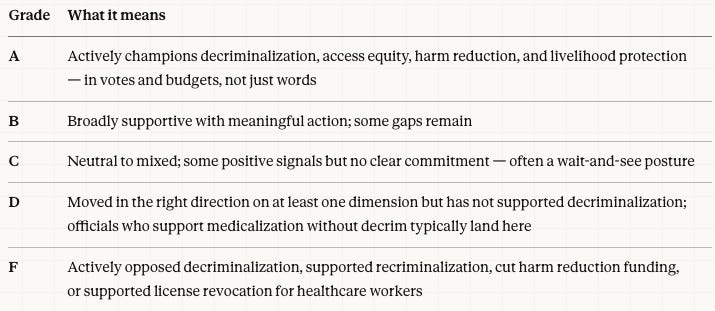
Important: silence is not neutral. An official with no stated position, no relevant votes, and no enforcement record does not start at C — they score C or below by default. The burden is on officials to demonstrate alignment, not merely to avoid active opposition. Grades follow an official across role changes; a record does not reset when someone runs for a new office.
The Mind Score is built from four components:
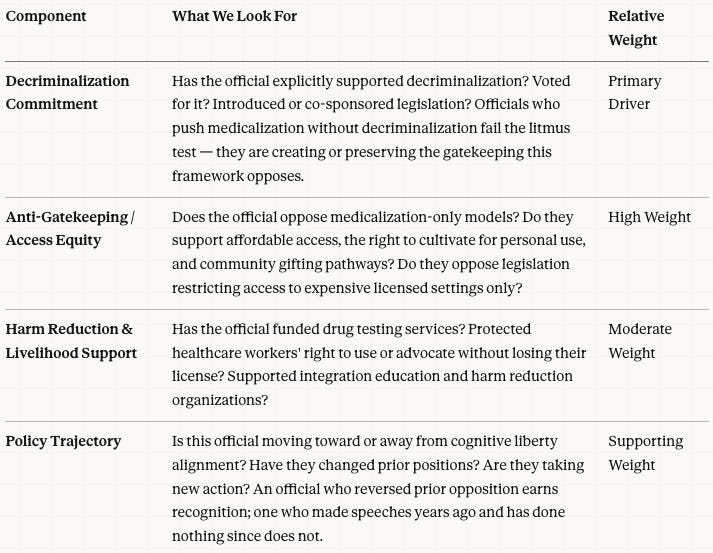
Exact component weights are not published — to prevent optimization for the score rather than for the underlying behavior.
The Mind Score and the SafeZone™ Score often diverge — and that divergence is itself informative.
The Psychedelic Friendly Mind Score:
How mental health and psychedelic friendly are these candidates?
Example: California 2026 Gubernatorial Candidates
This is an example of how this gets applied to individual candidates. By expanding the cards, you can see the key signals and cited evidence we can use in the framework to determine their grade.

The Psychedelic Friendly SafeZone Score:
“How likely am I going to be harassed, arrested, prosecuted?”
The SafeZone Score (0–100) answers the operational safety question for a specific place. It is built from four components — each measuring a different dimension of what actually determines whether a person faces criminal consequences for psychedelic use or for facilitating access.
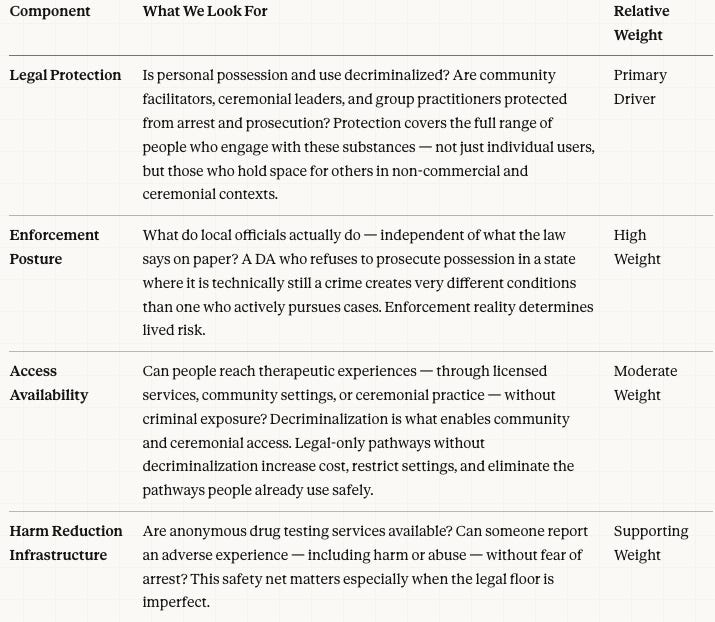
Mind Lumen follows the same transparency model as B Lab: we publish what we measure and why. We do not publish exact component weights or scoring thresholds, because doing so would allow officials and jurisdictions to optimize for the score rather than for the underlying behavior the score is designed to detect.
Critical modifier: Any jurisdiction that has medicalized access without decriminalizing personal use receives a significant score penalty. A model that opens therapeutic access only to those who can afford $1,500–3,500 per clinical session — while everyone else is criminalized — is not a safety improvement for most people. It is a two-tier system that the SafeZone score explicitly reflects.
Four Jurisdictions, Four Stories
Colorado — The Ballot Initiative State (SafeZone: ~73)
Colorado passed Prop 122 — the Natural Medicine Health Act — in November 2022 via ballot initiative, decriminalizing personal possession of psilocybin, psilocin, DMT, ibogaine, and mescaline (excluding peyote), while also creating a licensed Healing Center pathway for supervised therapeutic access. It’s currently the most comprehensive psychedelic policy in the United States.[1]
But here’s the nuance: voters led, officials followed. The law exists because Coloradans voted for it, not because legislators championed it. That distinction shows up in officials’ Mind Scores — those who supported Prop 122 earn in the B range, but with an asterisk: partial credit for following, not leading. A legislator who actively co-sponsored reform before the ballot initiative scores higher than one who simply didn’t oppose it after voters decided.
The state SafeZone average of ~73 masks enormous county-level variation. Boulder County scores around 85 — reform-aligned DA, supportive sheriff, licensed healing centers within 10 miles. Counties where local officials have taken opposing public positions may score 35–40. Same state law. Completely different lived reality.
The gaps that remain: no explicit professional license protection for healthcare workers who use or advocate, no statewide anonymous drug testing, and healing centers that are geographically and financially out of reach for most residents.
What would raise Colorado’s SafeZone: Explicit livelihood protections for licensed professionals. Sliding-scale healing center mandates. Statewide anonymous drug testing services.
What would raise officials’ grades: DAs and sheriffs publicly committing to non-prosecution and putting it on the record. Legislators introducing decriminalization bills — proactively, before voters force the issue. Commissioners passing formal county-level support resolutions.
Portugal — The Gold Standard for Decrim (SafeZone: ~85)
Under Law No. 30/2000, which came into force on July 1, 2001, Portugal decriminalized personal possession and use of all drugs — every substance class, no criminal penalty for a personal supply of up to ten days’ worth. No arrest pathway for possession. The system routes people toward Commissions for the Dissuasion of Drug Addiction, not courtrooms.[2]
Portugal scores ~85 on SafeZone because its Legal Protection, Enforcement Posture, and Access Availability components are all strong. Personal psychedelic use across every substance class carries no criminal risk. DAs don’t prosecute it. And critically — full decriminalization means people can access therapeutic experiences through underground, ceremonial, and community settings freely, without fear of arrest. Those pathways exist and are used. The harm reduction infrastructure is world-class: drug testing is legal and widely available, harm reduction centers are funded, and 25 years of non-judgment culture have been built into the social fabric.
Decriminalization also restores something criminalized jurisdictions deny: recourse. When someone is harmed — including sexual abuse in an underground or community setting — the crime is the abuse, not the substance. In a decriminalized environment, victims can come forward to law enforcement without fear of self-prosecution for their own drug use. (Note: Portugal’s specific legal treatment of underground facilitation, as distinct from personal use, is to be confirmed — the recourse principle is sound but its application in practice warrants verification.)
There are no licensed psilocybin therapy centers in Portugal, and that is not what holds the score back. Licensed centers are a complement to decriminalized access — a welcome addition alongside community and ceremonial pathways, not a requirement for high Access Availability. The framework does not penalize their absence.
Decriminalization is the ethical floor — and the foundation on which any kind of house can be built. Not a clinic. Not a licensed center.
A home, a forest, a ceremony, a community circle. Portugal laid that foundation definitively. What the framework looks for next is the accountability infrastructure for underground practitioners: Mind Lumen — an independent, seeker-focused audit and accountability watchdog with no provider conflicts of interest — tracks practitioner ethical conduct against observable, measurable, and auditable criteria, giving seekers and the public a transparent record that makes decriminalized access safer.
Officials who have sustained Law 30/2000 across multiple governments earn a B — a remarkable demonstration of civic commitment sustained over 25 years. Individual grades are held back by flat trajectory: no forward movement on a voluntary regulated framework alongside decrim, and no active legislative push on livelihood protections for professionals.
What would raise Portugal’s SafeZone: Filling the Access Availability gap — not by building expensive clinics, but by creating the accountability infrastructure that makes community and ceremonial pathways visible and recourse-capable.
What would raise officials’ grades: Moving from maintenance to momentum. A voluntary therapeutic framework that coexists alongside decriminalization — not replacing it. Legislation protecting professional livelihoods. Trajectory counts, and right now it’s flat.
Oregon — The Cautionary Tale (SafeZone: ~36)
Oregon was the world leader. In November 2020, voters passed Measure 110 — decriminalizing personal possession of all drugs, broader and bolder than anything in the United States before or since — and Measure 109, creating licensed psilocybin service centers. By 2022, Oregon looked like it might become the Portugal of the American West.[3][4]
Then, on April 1, 2024, Governor Tina Kotek (Grade: F) signed HB 4002, recriminalizing personal drug possession as a new “drug enforcement misdemeanor” — a category distinct from, and more serious than, the Class E violation that had existed under Measure 110. The criminal penalties took effect September 1, 2024. The bill passed with overwhelming bipartisan support: 51–7 in the House and 21–8 in the Senate.[5]
Oregon now has the exact combination the foundational framework explicitly opposes: a medicalized access model (expensive service centers in Portland and Bend, $1,500–3,500 per session) without decriminalization for personal use. People who cannot afford or access the licensed system remain criminalized.
The SafeZone Score (~36) reflects this: Legal Protection collapses to 22 under the medicalized-without-decrim penalty. The Enforcement Posture is below neutral (some DAs are now actively prosecuting post-HB 4002, others are not). Access Availability is limited and expensive.
The legislators who voted for HB 4002 — having previously supported Measure 110 — score F. This is the framework’s sharpest signal: a documented, public reversal of prior decrim support. The vote records are public. The Mind Score grade captures exactly what the framework is designed to surface: officials who said the right things and then did the wrong thing, under traceable circumstances.
What Oregon illustrates: The Mind Score grade is a different kind of accountability tool than the SafeZone Score. Even if Oregon’s enforcement posture softened (raising SafeZone), those legislators’ grades would still reflect the reversal. Behavioral history matters. Reversals matter. The grade doesn’t forget.
New Mexico — The Enforcement-Culture Gap (SafeZone: ~35)
On April 7, 2025, Governor Michelle Lujan Grisham signed Senate Bill 219 — the Medical Psilocybin Act — into law, effective June 20, 2025. It creates a licensed therapeutic pathway for psilocybin for qualifying conditions including treatment-resistant depression, PTSD, and substance use disorders. Notably, it is the first legislature-driven psilocybin access act in the United States — passed by lawmakers, not ballot initiative, with strong bipartisan votes: 33–4 in the Senate and 56–9 in the House. No decriminalization alongside it. Medical access only; personal use remains criminalized.[6]
On paper, this looks like Oregon: medicalized without decrim, SafeZone penalty applied, Legal Protection at ~22. And the SafeZone Score (~35) is indeed similar to Oregon’s.
But the Mind Score grades for New Mexico officials diverge from Oregon’s. Why?
Because New Mexico’s officials haven’t reversed anything. Governor Lujan Grisham and the legislators who passed SB 219 score in the D range — not a passing grade, but meaningfully above F. They moved forward — imperfectly, in the wrong model (medicalized-only), but with genuine intent and no prior betrayal on their record. The trajectory is positive. The city councils in Santa Fe and Albuquerque have been discussing local reform. No one passed a decrim law and then repealed it.
There’s also an enforcement culture difference. New Mexico DAs have historically not prioritized personal drug possession cases. The Enforcement Posture component (~62) is meaningfully higher than Oregon’s state average (~45 post-repeal). A seeker in Albuquerque faces a different practical reality than the law on paper would suggest — and the SafeZone Score captures that gap.
What the New Mexico divergence illustrates: A low SafeZone alongside higher individual Mind Score grades means officials are trying but the law hasn’t caught up. Credit is given for intent and direction, even where legal protection is still absent. It also means a voter in New Mexico can see clearly what the next step should be — decriminalization legislation, not just medical expansion — and hold their officials to it.
Why Two Scores?
Because “is it safe here?” and “do my officials actually support this?” are not the same question — and conflating them produces bad information and bad strategy.
A seeker needs to know their actual risk in a specific place. A voter needs to know whether their specific officials are worth re-electing. These are different decisions requiring different data. A single score obscures both.
The four case studies above show how the two interact — and what that tells advocates, voters, and seekers about where to direct their energy:
Colorado shows that the law can move faster than its stewards. High SafeZone alongside B grades (not A) for many officials signals exactly what to do next: push officials to lead, not just follow. Introduce bills. Take public positions. Don’t wait for the next ballot initiative.
Portugal shows that the foundation is worth building and worth defending. Maintaining decriminalization across political transitions for 25 years is itself a form of commitment. What advocates should be pushing for next: momentum, not maintenance.
Oregon is the cautionary tale every jurisdiction should internalize. SafeZone and official grades are not independent — officials are the mechanism by which safe places become unsafe ones. F grades are traceable to specific votes, in public record, by specific individuals who made a choice.
New Mexico shows that credit is given for direction, even where the law hasn’t caught up. Officials who move forward — even imperfectly — score above those who stand still or reverse. That is a signal to advocates: the path toward decriminalization is achievable, and the officials who walk it will be recognized for it.
When you look up your county in Mind Lumen’s framework, you will see the SafeZone for the place and the grades for the people who govern it. Both are designed to update as conditions change — an election, a vote, a reversal, a new bill. The scores are living numbers. The grades are based on public records.
The Litmus Test
The Cognitive Liberty framework reduces to one question for every elected official whose role gives them authority over whether someone is arrested, prosecuted, or fined for psychedelic use:
“Do you support cognitive liberty and decriminalization?”
Not “do you support supervised psilocybin therapy for treatment-resistant depression?” Not “do you support a regulated medical framework?” Those are fine things to support. But they are not the ethical floor.
The floor is decriminalization — removing personal possession and use from the criminal system entirely, for everyone, regardless of whether they can afford a therapy session or navigate a complex and expensive healthcare system that was never designed to serve them.
This framework is a conversation and a tool. It is designed to help seekers understand where they are safe, help providers understand where they can operate, help voters understand who is actually aligned with mental health access, and help advocates identify exactly what they need to ask of the officials who represent them.
The Mind Score grade is how we can hold officials to that question. Not with their words - with our votes!
Mind Lumen is researching and building a system that plans to publish both scores with full evidence trails — verbatim quotes, source URLs, vote records, and community organization submissions. The score synthesizes. The evidence speaks. Every voter sees both.
We welcome collaboration - please reach out
References
[1] Colorado Proposition 122 — Natural Medicine Health Act (2022). Official ballot text and analysis: https://content.leg.colorado.gov/sites/default/files/images/2021-2022_58vbb.pdf — Implementation bill SB23-290: https://vicentellp.com/insights/ultimate-guide-to-sb23290-colorado-natural-medicine-psychedelics-regulation-and-legalization-bill/
[2] Portugal Law No. 30/2000 — Decriminalization of Drug Use, in force July 1, 2001. Library of Congress legal analysis: https://loc.gov/law/help/decriminalization-of-narcotics/portugal.php — EU Drugs Agency policy profile: https://www.euda.europa.eu/system/files/publications/642/PolicyProfile_Portugal_WEB_Final_289201.pdf
[3] Oregon Measure 110 (2020) — Drug Decriminalization and Addiction Treatment Initiative. Oregon Secretary of State: https://sos.oregon.gov/admin/pages/measure110.aspx (verify URL)
[4] Oregon Measure 109 (2020) — Psilocybin Services Act. Oregon Health Authority psilocybin program: https://www.oregon.gov/oha/ph/preventionwellness/pages/psilocybin-services.aspx (verify URL)
[5] Oregon HB 4002 (2024) — signed by Governor Tina Kotek on April 1, 2024; criminal penalties effective September 1, 2024. Oregon Legislative Information System: https://olis.oregonlegislature.gov/liz/2024R1/Measures/Overview/HB4002 — OPB coverage: https://www.opb.org/article/2024/04/01/oregon-governor-signs-bill-criminalizing-drug-possession/
[6] New Mexico Senate Bill 219 — Medical Psilocybin Act, signed April 7, 2025, effective June 20, 2025. Official bill text: https://www.nmlegis.gov/Sessions/25%20Regular/bills/senate/SB0219.HTML — NM Department of Health program page: https://www.nmhealth.org/about/mcpp/mpp/